
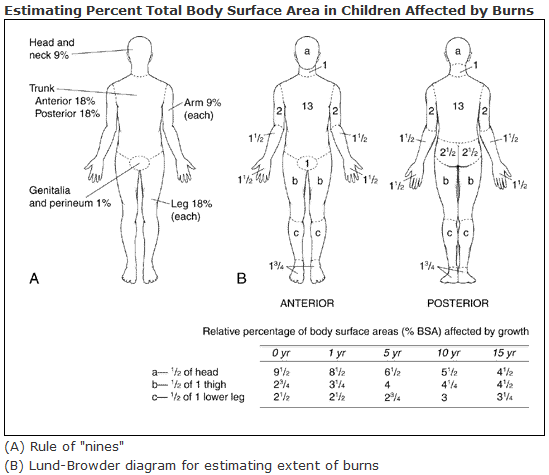
Burns March 2018 | by EMauthor Burns are a common presentation. Major burns, when assessed pre-hospital will be conveyed straight to a major trauma centre although this can be difficult for crews to assess. Also, significant burns can occasionally get themselves in under their own transport; so do not assume all burns will be minor. Aside from this, many burns especially those in 'special areas' can have profound implications and may need a referral to the burns unit. Estimating the size of a burn There are several different methods for estimating the size of a burn. Size should only include those burns that are partial or full thickness; superficial burns should not be included. Methods of size estimation: •Rule of 9s (below) •Lund–Browder charts (below) •Patient’s palm size (including the fingers) = approximately 1% body surface area.
The release of cytokines and other inflammatory mediators at the site of injury has a systemic effect once the burn reaches 20-30% of total body surface area (BSA) leading to a SIRS type pattern and organ failure. Estimating the depth of a burn The depth of burn is important in evaluating the severity of the burn, planning for wound care, and predicting functional and cosmetic results. •Superficial oDamage to the epidermis only. oRed and dry. oBlanch with pressure. oVery painful. oHeals within ∼10 days. oNo scarring. •Partial thickness oDamage to epidermis and dermis (dermal involvement may be superfi cial or deep). oBlisters and oedema. oPainful. oHealing occurs in 14 days. oDepigmentation may occur. oMay require skin grafting. •Full thickness oLoss of all layers of skin. oMay appear dark and leathery or waxy-white. oInsensate (painless). oNo blanching. oSkin grafting required. Site of the burn Burns at certain sites require specialist intervention and referral on to a burns’ centre. These ‘special’ sites include: Face, Eyes, Ears, Hands, Feet, Genitalia and perineum, or overlying major joints. Circumferential burns must be identified because of the risk of a tourniquet effect. The neurovascular status of limbs should be assessed and if there is neurovascular compromise an escharotomy may be required. ED management •Generic trauma management principles should be followed. •Potential airway injury should be considered and the patient intubated if there is concern. •Hypothermia should be avoided by keeping the patient covered and warm. •Fluid resuscitation is paramount oParkland formula: oPercentage burn (partial and full) × weight (kg) × 4 = total fluid (ml). oThis calculates the total volume required for the first 24 h of resuscitation. oHalf should be given over the first 8 h and half over the next 16 hs. •Intravenous opiates should be given for analgesia. •Dressings oPartial thickness: non-adherent dressing oFull thickness and deep dermal: cover with loose, longitudinal strips of cling Film, elevate limbs •Jewellery that may tourniquet limbs or digits should be removed. •Tetanus status should be determined and prophylaxis given, if necessary. •Prophylactic antibiotics are not recommended Referral criteria
Follow guidance on the London and South East England Burn Network guidelines page. Our nearest burns unit is St Andrews Burn Centre, Broomfield Hospital, Chelmsford. Phone 02033152500, ask for 'burns referrals'. For image transfers use trips.nhs.uk. |
Links •HOME |
Created with the Personal Edition of HelpNDoc: Free Web Help generator